1. The Core Announcement & Facts
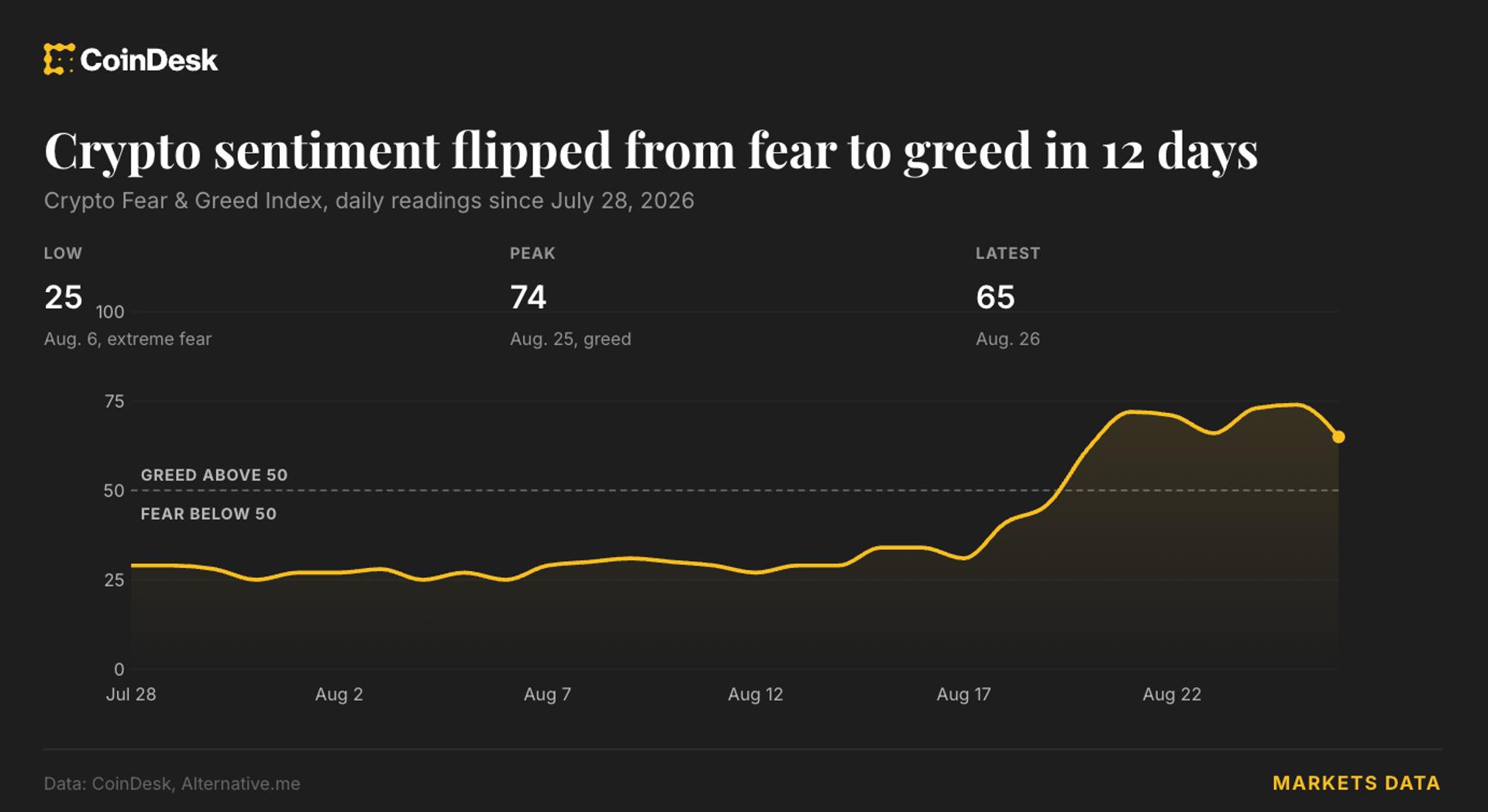
The digital asset market's prominent sentiment metric has officially surged to its highest level since immediately prior to October’s catastrophic $19 billion market wipeout, according to reporting from CoinDesk FinTech & AI. The index, which quantifies market psychology on a normalized scale, indicates that market participants have entered a zone of extreme optimism following sustained price appreciation across major cryptocurrencies.
This surge in market sentiment mirrors the conditions recorded late last year when over-extended leverage across major derivatives exchanges culminated in a swift, market-wide liquidation event. Tracing back to that $19 billion leverage flush, analysts highlight that periods of extreme greed often correspond with over-leveraged long positions in perpetual swap contracts, leaving the wider market vulnerable to abrupt price corrections.
2. Market & Industry Impact
From a macroeconomic perspective, an overheated sentiment gauge signals heightened structural risk for both institutional traders and retail market participants. When market optimism reaches historical peaks, derivatives funding rates typically turn heavily positive, meaning long position holders pay high premiums to maintain their positions. If spot market buying fails to absorb profit-taking pressure, a minor downside movement can rapidly trigger automated liquidation orders across global exchanges.
For enterprise digital asset firms and liquidity providers, this dynamic shifts portfolio management strategies away from unhedged long exposure toward risk-neutral hedging. Institutional desks are increasingly utilizing options strategies—such as protective puts and collar positions—to insulate balance sheets against sudden volatility spikes that could replicate the rapid capital destruction seen during October's deleveraging spiral.
3. Technical Analysis & Architecture
Technically, market greed indicators synthesize multi-factor inputs to compute market overheating. These engines typically evaluate order book depth, annualized funding rates across top perpetual swap venues, 30-day implied volatility surface shifts, relative trading volume ratios, and natural language processing (NLP) sentiment metrics derived from social feeds and news wires. When these independent data streams converge at multi-month highs, the normalized output flags an elevated probability of order-book imbalance.
When sentiment reaches extreme greed while exchange open interest remains near peak capacity, the liquidation engine mechanism of centralized matching nodes presents single-point tail risk. If price action drops below critical maintenance margin thresholds, exchange risk engines execute market orders to liquidate underwater positions. In thin liquidity environments, these automated engine sweeps consume available bid liquidity, causing bid-ask spreads to blow out and creating self-reinforcing liquidation cascades across inter-exchange arbitrated liquidity pools.