1. The Core Announcement & Facts
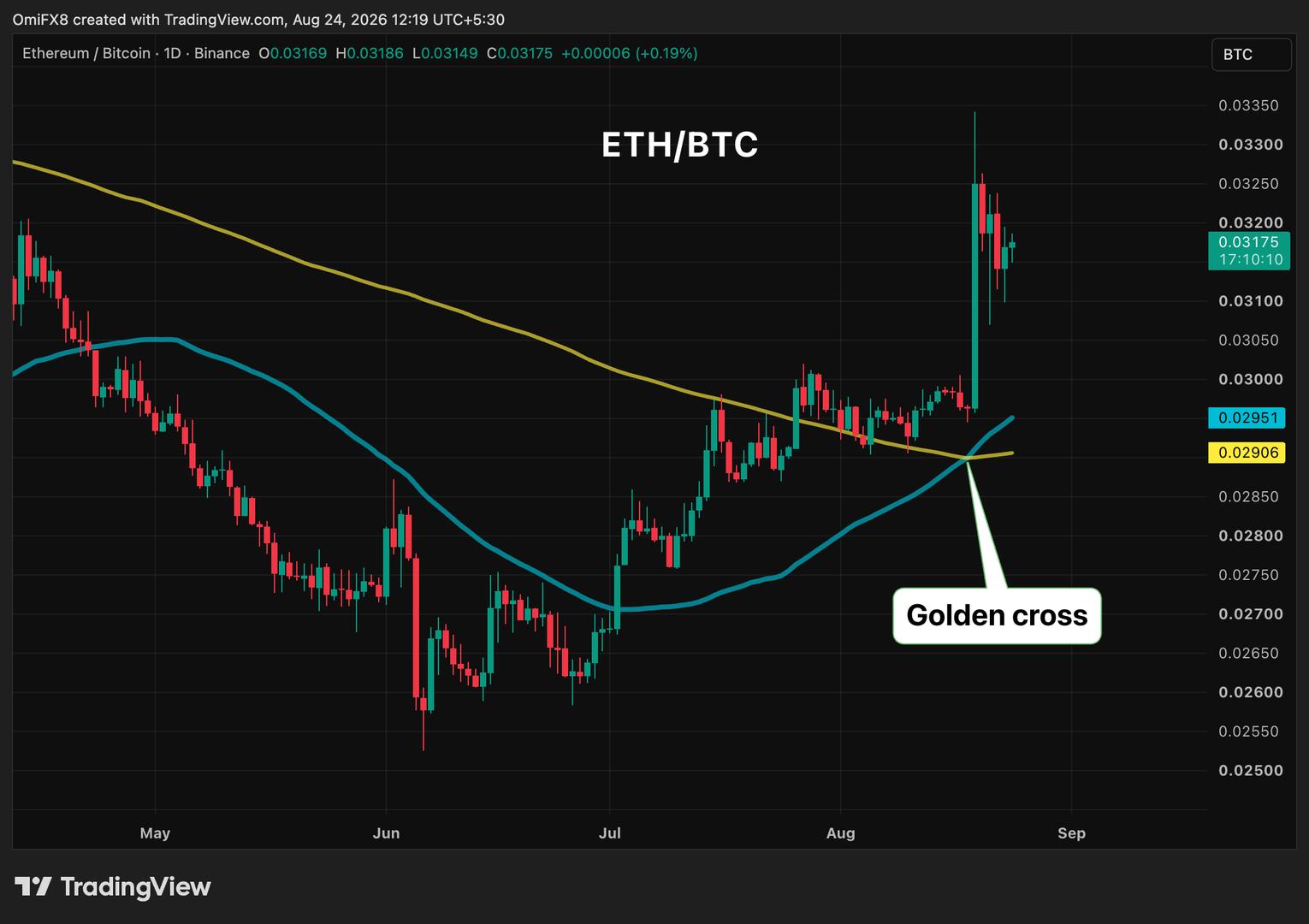
In a notable shift across digital asset markets, Ether (ETH) has demonstrated marked outperformance over Bitcoin (BTC), reinforced by a key technical indicator known as the 'golden cross.' As reported by CoinDesk on August 24, 2026, the bullish pattern—formed when an asset's short-term moving average (typically the 50-day) crosses decisively above its long-term moving average (typically the 200-day)—signals a potential continuation of relative upside for the market's second-largest cryptocurrency by market capitalization.
The momentum shift on the ETH/BTC cross suggests that traders and institutional desks are shifting risk allocations. While Bitcoin led earlier market cycles behind ETF inflows and sovereign treasury adoption, current capital flows indicate an increasing preference for Ethereum's productive yield, decentralized ecosystem activity, and relative valuation catch-up.
2. Market & Industry Impact
From a macroeconomic perspective, Ether's outperformance relative to Bitcoin reflects a broader risk-on appetite within the digital asset sector. When liquidity flows from Bitcoin—often treated as a non-sovereign digital macro hedge—into Ether, it typically indicates growing market confidence in protocol revenue, decentralized application usage, and tokenized real-world asset (RWA) infrastructure. Yield-seeking behaviors have intensified as native Ethereum staking yields offer a compelling delta against fluctuating traditional fixed-income returns.
Furthermore, digital asset management firms adjusting multi-asset portfolios are rebalancing target weights to capture on-chain execution fees and staking rewards. This reallocation creates sustained spot demand while shifting options open interest and futures funding rates in favor of Ether derivatives across global trading venues.
3. Technical Analysis & Architecture
Underpinning the technical momentum are programmatic network fundamentals. Ethereum's ongoing architecture refinements, particularly around data availability scaling via Proto-Danksharding (EIP-4844), have substantially lowered transaction overhead for Layer-2 rollup frameworks. This operational efficiency has driven record ecosystem transaction throughput without destabilizing Layer-1 gas fees, cementing Ethereum's position as the primary settlement layer for decentralized finance.
Additionally, Ethereum's Proof-of-Stake (PoS) consensus framework and EIP-1559 fee-burn mechanism continue to alter the asset's supply dynamics during periods of high network utilization. With significant portions of total ETH supply locked in staking contracts and smart contracts, systemic sell-side liquidity remains constrained relative to Bitcoin's static issuance model, amplifying upward price response during high-demand regimes.